|
Liquid interfaces and monolayers, particle rafts
|
|
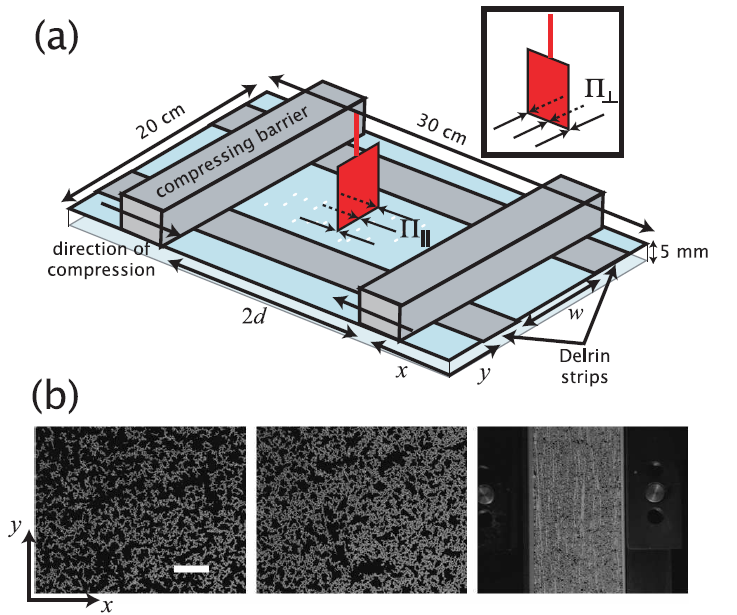
Diagram of customised Langmuir trough setup, used to study stress propagation in two dimensional layers. Images show rafts of large and rough-shaped rubber particles. Recent work has shown that stress is transmitted through these layers in a similar way as in piles of grains.
|
This is the longest running research line, dating back to Pietro's PhD and first post-doc. We addressed in particular the problem of how polymers form monolayered films on interfaces, and the physics properties of these structures. We are also working on protein films of industrial interest such as hydrophobin, and on the behavior of colloidal particles and grains (rafts) confined to two dimensions. Various new methods have been developed to characterise surface viscoelasicity, including modifications of the Langmuir trough and Surface Dynamic Light Scattering. A lot of our work has been done in collaboration with Dominic Vella now in Oxford, especially on wrinkling of films on liquid substrates.
Models for the role of Lipids in Cell Membranes
|
|
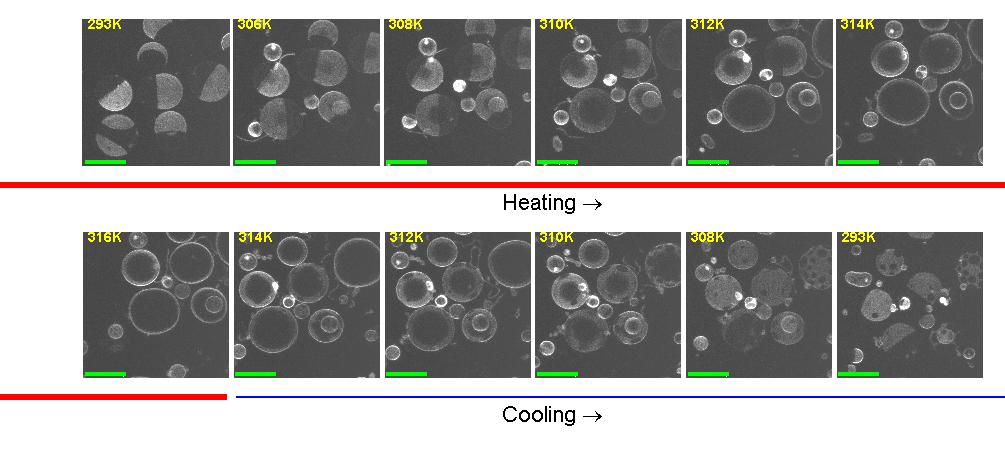
Ternary mixtures of phospholipids and cholesterol phase separate below a critical temperature. Phase separation is imaged in fluorescence, thanks to the preferential partitioning of a fluorescent dye into one phase. This process may have a role in regulating biological activity at membranes.
|
Membrane mechanics is characterised by bending, shear and compression moduli. Furthermore, multicomponent membranes can phase separate, and in this case each phase has different moduli, and there is a line tension between the coexisting phases. Working with giant vesicles that mimic the composition of biological cell membranes, we are trying to understand the coupling between the phase behavior and the membrane properties. We are also still active to explore the consequences in cell biology of "critical lipidomics", i.e. the finding (with Sarah Veatch) that the plasma membrane of cells has a lipid composition poised close to liquid-liquid phase separation.
Functionalised and Functional Membranes
Starting in 2014 we have developed a class of really interesting systems based on combining the lipid membrane degrees of freedom, with DNA nanotechnology. The DNA binders allow to tune adhesion in specific and
information-processing fashion, to build systems that have fascinating physical properties as well as mechanical and logical response. This has been in collaboration with Lorenzo Di Michele and his group, especially Roger Rubio Sanchez.
A review of a large body of papers and theoretical background is [B. Mognetti, P. Cicuta and L. Di Michele, Rep. Progr. Phys. 82, 116601 2019]. Very nice science, many papers, since then!
Attaching DNA constructs to lipid bilayers is achieved with cholesterol (or other sterol) anchors. It has turned out that these DNA plus cholesterol units have themselves a very rich soft matter behaviour, see papers on C-stars. Working with the stars and their phase diagram has then inspired another stream of work on DNA and RNA condensates, including condensates induced in live cells, see current work in Lorenzo's lab.
Cell Membrane Mechanics
|
|
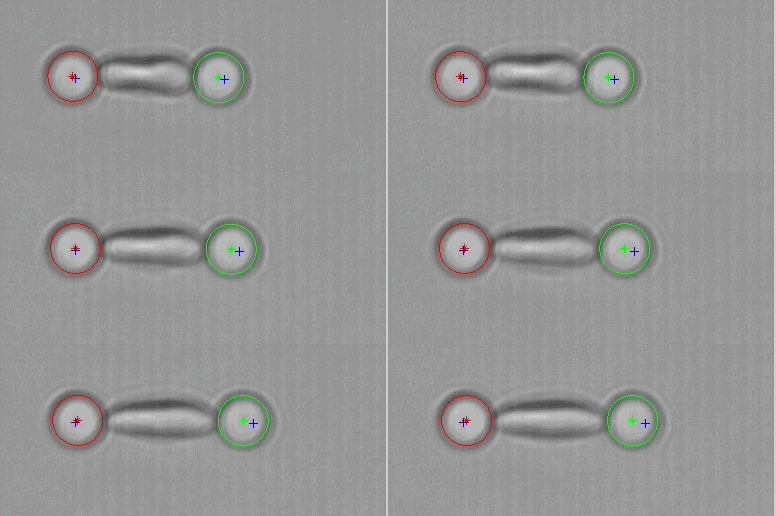
An erythrocyte (red blood cell) is "grabbed" at opposite ends by a pair of colloidal particles held in optical traps. The cell is dynamically stretched, measuring its mechanical properties.
|
We have been studying the Red Blood Cell, which has a relatively simple membrane structure made of a phospholipid bilayer tethered to a thin cortical network of semiflexible filaments. We have observed very complex dynamics upon stretching the cell, which we have interpreted as a stress induced remodeling of the cytoskeletal network. This, and the use of optical tweezers to measure forces, has also linked to the study of blood stage malaria host-pathogen interactions.
This work has recently been at the heart of Filip Ayazi's PhD, and collaboration with Sebastian Krauss currently Oppenheimer Research Fellow.
|