|
Motile cilia and hydrodynamic interactions
An open problem in biology and physiology is how the motile cilia coordinate their beating to generate fluid flow in the airways and other ciliated tissues, or to enable the motility of microorganisms. The difficulty and hence the challenge for physicists, lies in the fact that the dynamics is non-linear, both at the level of each cilium, and in the coupling between them. Solving this would have impact in medicine, since establishing a link between the behaviour of the single filament and the collective motion would allow us to diagnose readily between various cilia pathologies.
We have been working to understand the mechanisms of fluid propulsion and synchronisation that take place in many biological systems thanks to coordinated motion of motile cilia.
Since 2016 we have also been working with ciliated mammalian cells, this built on studies of hydrodynamic coupling between driven colloidal particles in solution.
We have been developing a physical framework to explain the many-cilia dynamics (metachronal waves) as an emergent phenomenon made possible by the detailed beating properties of
each cilium.
Model system with driven colloids
|
|
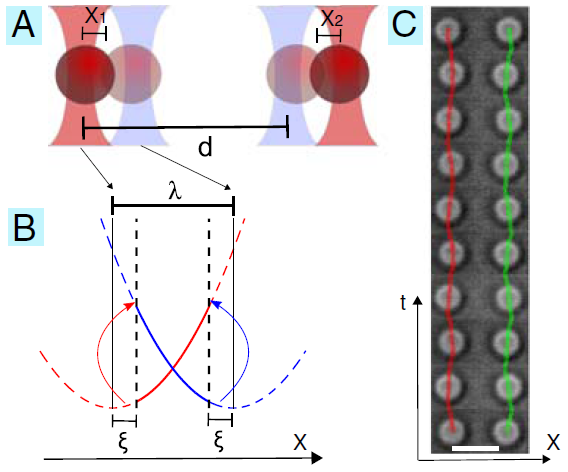
Illustration of the model experimental system we have developed to
study the hydrodynamic interaction of colloidal oscillators.
|
An experimental model system has been developed using feedback-controlled
optical tweezers. Driven oscillations of colloidal particles, of fixed amplitude but free
inphase, are achieved. The trap alternates between two
minima with a geometric switch triggered by the position of the colloidal
particle. In the figure, (A) and (B) illustrate the experimental parameters. The distance between trap pairs is in
the range 4 to 40 micron. (C) shows timelapse images of two particles locked in antiphase. Particle
positions are overlayed on the image sequence. Antiphase motion
can be seen. This result is from our first experiment, published in PNAS in 2010. Since then we
have studied more general geometric conditions, including many oscillators, and the effect of changing the driving potential shape
from harmonic to other forms.
We have also studied this model in a number of theoretical and numerical papers - there is a lot of rich physics, which we continue to pursue.
The PhD work of Evelyn Hamilton led to a number of theoretical insights into how to coarse-grain rower models to an effective theory for the phase-differences.
Synchronisation of colloidal rings
|
|
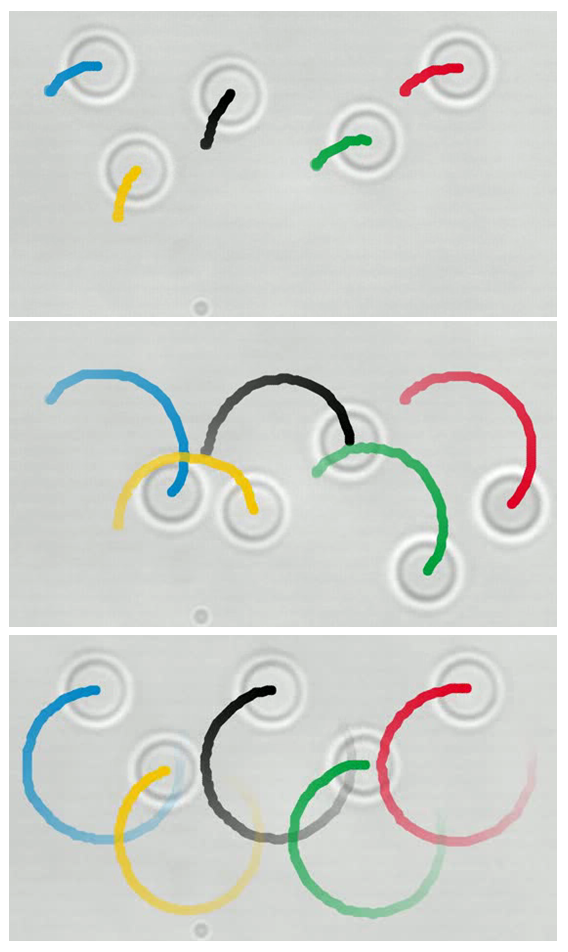
Five colloidal beads are moved with optical traps, with fixed force. They start at random angular positions, and self-coordinate to rotate in-phase. Figure shows three moments of an experiment, and overlaid in color sections of previous trajectories.
|
Model experiments using systems of colloidal scale particles driven by optical traps started in [J.Kotar et al., Proc. Natl. Acad. Sci. 107, 7669-7673 (2010); N.Bruot et al., Phys.Rev.Lett. 107, 094101 (2011)] gave us key insights into the conditions for hydrodynamic synchronisation. We first studied the so-called rower (or geometric-switch) model. Later with Nicolas Bruot and Jurij Kotar we also started investigating the so-called rotor model system, proposed in [T.Niedermayer et al., Chaos 18, 037128 (2008)] in which particles are pushed with constant force along pre-defined closed trajectories (orbits). Since only the force is constant, the phase at which the particle travels around the orbits is free: These are phase oscillators. Through the fluid flow, they are coupled, and we see that they exhibit synchronisation.
We have performed a variety of experiments on this system including a very comprehensive study with experiments by Jurij and Armando Maestro, and theory by N.Uchida and R.Golestanian [
A.Maestro et al., Communications Physics 1, 28 2018]. One particularly captivating arrangement is five beads, as seen in the image evolving in time: The five beads, each a few micrometers in diameter, are initially held by optical tweezers in random positions. Then each one is pushed, on a pre-defined circular trajectory, with constant force. In addition to the tweezers' constant force, they feel the fluid flow from neighbours, and after a couple of orbits they are synchronised, and proceed to rotate thereafter in-phase (last panel).
See the full movie in real time here .
Studying the synchronized states in these simple model systems is helping us to understand the more complex behaviour observed in nature, got us ready for the 2012 Olympic Games.
Live ciliated epithelia
Our initial work started with L.Feriani and M.Chioccioli. We developed in particular video analysis tools to characterise cilia motion and specifically the coordination scales of cilia dynamics across tissues. We called the main technique multiscale DDM (multi-DDM)
[L.Feriani et al., Biophys. J. 113, 109-119 2017]. This was demonstrated on CF cells in [M. Chioccioli*, L. Feriani*, et al., Nature Communications 10, 1763 2019] and we continue to develop it to characterise ciliary and other dynamics.
The PhD of Nicola Pellicciotta looked at brain cells in culture, leading to two key papers showing the conditions for which external flows can impose a beating frequency, and a permanent alignment. We collaborated with Eric Lauga and his team on the hydrodynamic modelling of beating filaments, which went beyond the point force flows of our colloidal models described above. Nicola has continued as an academic in this field, and now has a permanent position in Rome La Sapienza physics department.
The PhD of Erica Causa looked at the transport of fluid in the region very close to the ciliated cells, the periciliary layer (PCL). Un-caging a fluorescent dye it was possible to measure both the diffusion and the advection of the dye molecules, in precise points of the PCL. We collaborated with Debasish Das (Strathclyde) on the hydrodynamic modelling, enabling us to make a link between the flow in the PCL and the coordination across arrays of cilia.
A variety of group members have been working on optimising cell culture platforms, protocols and conditions.
We are very active in this area, with current funding from GSK and from Wellcome Trust. The WT project is in collaboration with the team of Paola Borri in Cardiff, and will focus on measuring the mucus properties of airway cell mucus in situ, in health and disease, and how this is regulated by the cells.
|