Search A-Z index Help
University of Cambridge Home Physics Dept Home BSS Home

Biological Physics of Bacteria

Local packing of the chromosome from loci motility

loci project

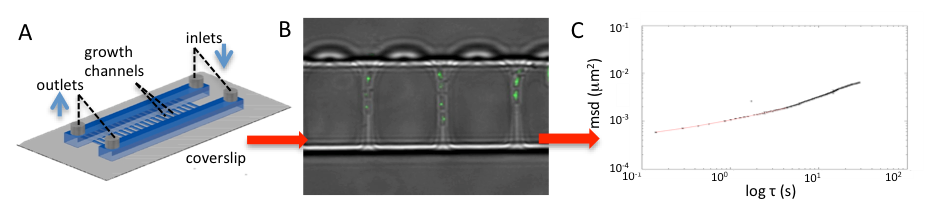
Left panel shows a schematic of the channel device used to grow and image bacteria. Sustained exponential growth is achieved, and can be maintained for a few days. Central panel shows an image in which fluorescent (green) dots are visible inside bacteria; the light is emitted from GFP bound to one particular chromosomal locus. The dots can be traced in time, and the mean square displacement is obtained (right hand panel). Watch this space for the results of this!

The question that started our bacterial interest, in an HFSP funded collaboration with Marco Cosentino Lagomarsino, Bianca Sclavi, Kevin Dorfman, and with Gillian Fraser in Pathology, concerned the physical structure of the bacterial nucleoid (the genome plus associated bound proteins), and how this in turn affects the fundamental biological processes.
This research brings together a key biological processes (replication), with polymer physics, and cutting edge microfluidics and imaging technology.

We spawned a conference

With Madan Babu and Mario Nicodemi we organised first in Sept 2011 a very successful meeting on Quantitative Methods in Gene Regulation . A second edition took place in 2013 (with Marco Cosentino Lagomarsino, Mario Nicodemi and Sarah Teichmann), a third and fourth in 2015 and 2017 also with Oliver Stegle and Sebastian Ahnert. The 2019 edition (with Marco, Martin Howard and Alison Smith) returned to London, in the new IOP building. Since then the meeting has been incorporated as a session in the large-scale biannual Physics of Life UK meeting, organised by PolNet.

Physiology of Bacteria

I'm very proud of a paper that came from the MPhil work of the super talented Andrew Kennard. Using culture and imaging techniques that were state of the art at the time for throughput (and a lot of careful work) Andrew studied E.coli in a variety of growth conditions, and established some universal laws in the shape of the growth rate distributions. [A.S. Kennard,et al., Phys. Rev. E 93, 012408 2016]

Later with the PhD of Mia Panlilio we looked into how gene expression and growth rates respond to sudden changes in nutrient [M.Panlilio, et al., PNAS 118, e2016391118 2021], using the mothermachines we started developing a while back [Z. Long, et al., Lab on a Chip 13, 947-954 2013].

Resistance to Antibiotics, and systemic effects

Antimicrobials can be used to selectively perturb cells; this led us to see a great variety of effects on cells, beyond the specific molecular target of the drug. In turn this led to the PhD of Morten Kals, focused on obtaining large datasets of cell shapes and growth rates, on a variety of bacterial species. We've published a couple of papers [M. Kals, et al., PLOS Pathogens, 21, e1012924 2025] and are still interested in that question.

With Leonardo Mancini, bacterial biologist now Faculty in Glasgow, we've explored a great deal of bacterial questions recently. Perhaps the most surprising discovery to me has been the work on three species community, in conditions matching lung environment, showing the dominant role of geometric confinement in selecting the dominant species. In confinement, Candida fungus out-competes its bacterial neighbours, which is the opposite outcome from well mixed conditions. [L. Mancini, et al., ISME Journal, in press 2025]

Bacteria in nature often grow in confinement. This was a theme we addressed already a long way back with Bartlomiej Waclaw and Rosalind J. Allen, showing that physical forces built up in the initially two dimensional colony growth determine after a certain size the pushing out of bacterial cells to make a three dimensional colony [M.A.A. Grant,et al., J. Roy. Soc.: Interface, 11, 20140400 2014]. It is in fact still a theme we are working on with Rosalind.