
 The latest:
Thermal and Photo-Actuators!
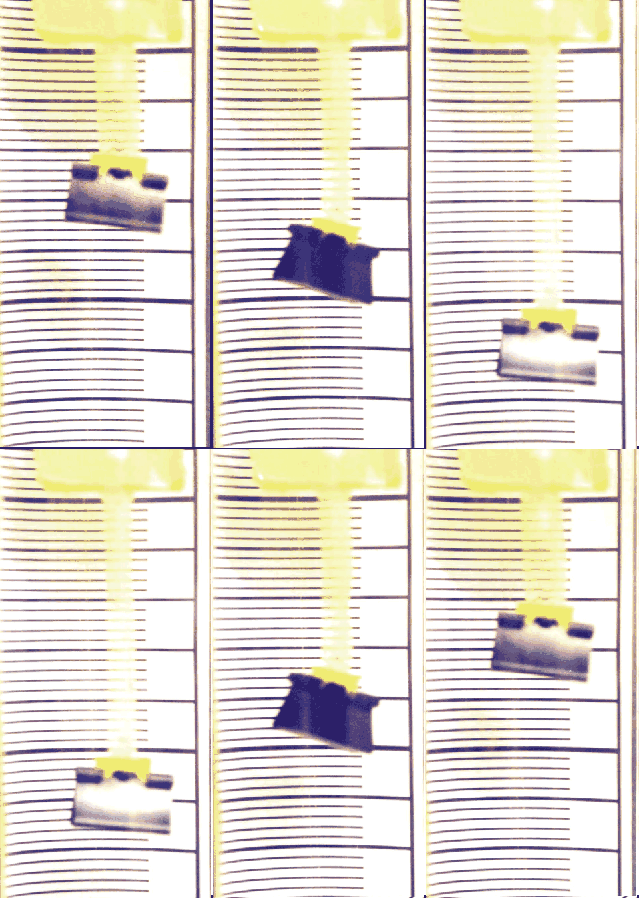
The animation is just to show the extent of spontaneous thermal expansion of
The latest:
Thermal and Photo-Actuators!
The animation is just to show the extent of spontaneous thermal expansion of
 monodomain (uniaxially aligned) nematic elastomers, as it it heated above and then cooled back
below its nematic-isotropic transition point. See some more serious papers on the
subject, by our group and by H. Finkelmann,
which also discuss possibilities of using these effects in thermo- and photo-mechanical actuators.
monodomain (uniaxially aligned) nematic elastomers, as it it heated above and then cooled back
below its nematic-isotropic transition point. See some more serious papers on the
subject, by our group and by H. Finkelmann,
which also discuss possibilities of using these effects in thermo- and photo-mechanical actuators.
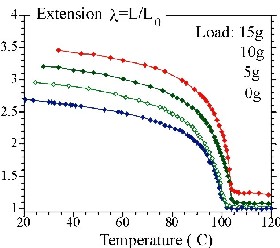
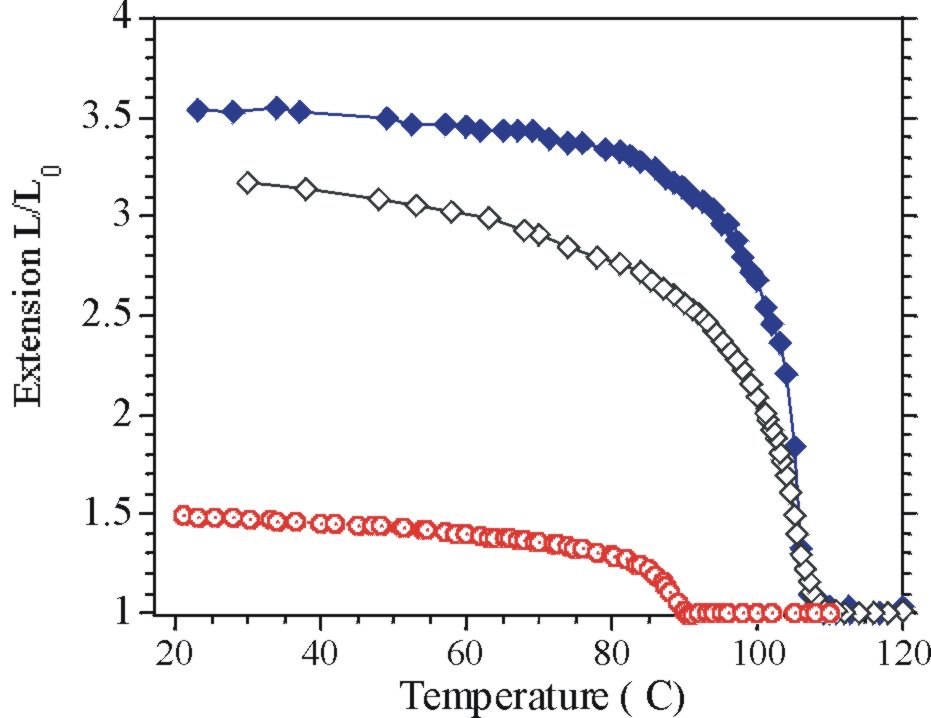
Very high amplitude (and high force exerted) make these artificial muscles very attractive! The plot on the right shows a typical variation of sample length L (along the nematic director), with respect to this length in the isotropic phase, L0: Several different materials show the same qualitative features, but rather different amplitudes (from 10-50% to 300% and more); transition temperatures could be made different too.
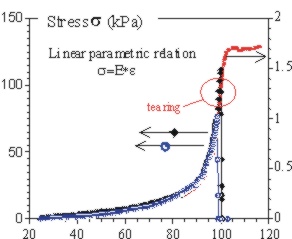
The work cycle of such an artificial muscle depends on the amplitude of motion, but also on the force the nematic rubber exerts -- or the load it can work under. The plots below show: (a) Extension l = L(T)/L0 on cooling cycles under increasing load, corresponding to stress of 0, 30, 60 and 90kPa; (b) The stress (force per 1 area) exerted by a clamped strip, heated from the room temperature. Symbols are the data points from different samples which were tearing at a stress of about 100kPa (circled); the red line is the plot of underlying effective strain e = [L-L0(T)]/L0 (values on the second y-axis)
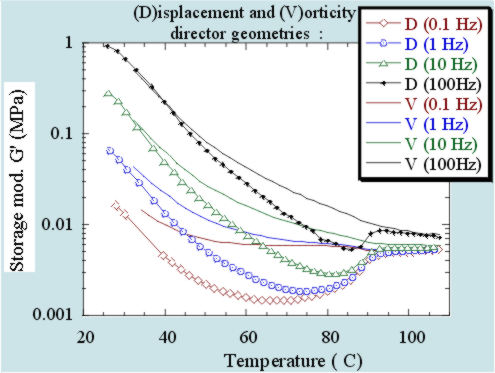
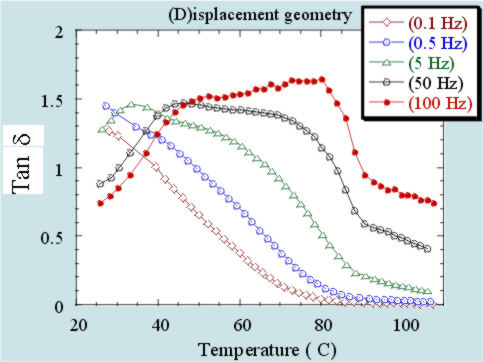
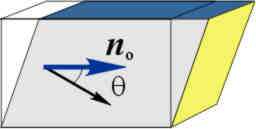
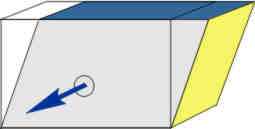 In the second case, the "log-rolling", there is no internal director rotation
and the storage modulus G' (in MPa) monotonously increases on cooling
(trivially approaching the glass transition far below).
In contrast, when in the (D) geometry the director is forced to rotate
- we notice a dramatic decrease in the effective modulus G'. This
is another representation of "soft elasticity"! The
loss factor G''/G' reaches enormously high values.
In the second case, the "log-rolling", there is no internal director rotation
and the storage modulus G' (in MPa) monotonously increases on cooling
(trivially approaching the glass transition far below).
In contrast, when in the (D) geometry the director is forced to rotate
- we notice a dramatic decrease in the effective modulus G'. This
is another representation of "soft elasticity"! The
loss factor G''/G' reaches enormously high values.
People think this might have a big impact on damping technology - from making quieter cars and refrigirators, to damage-control of jet engine turbines...

 The
latest... Let's return to Liquid
Crystal Colloids.
We know colloid particles wouldn't like to be homogeneously dispersed in
a nematic matrix - they will aggregate to reduce the elastic energy. Well,
in some cases we can make them aggregate into a really rigid
cellular
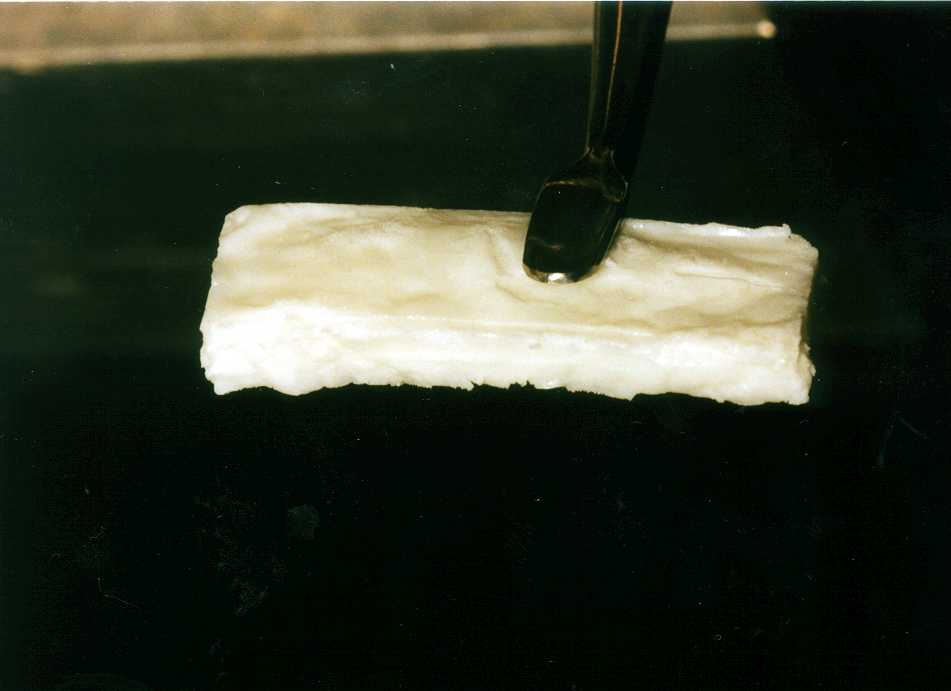
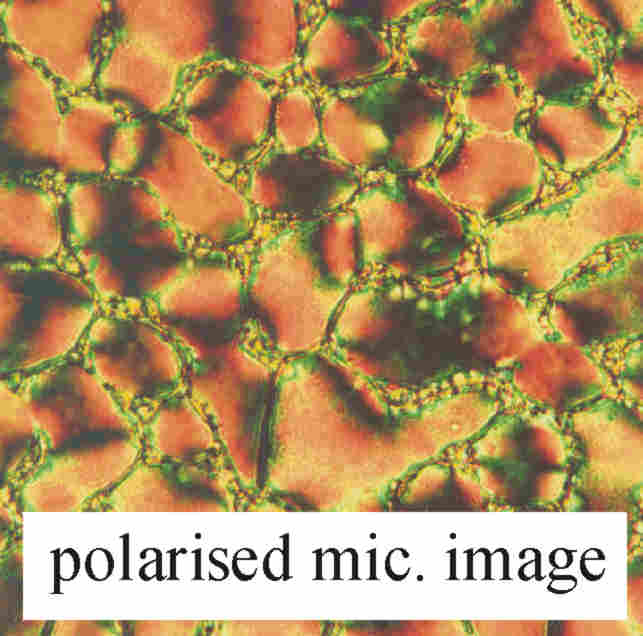
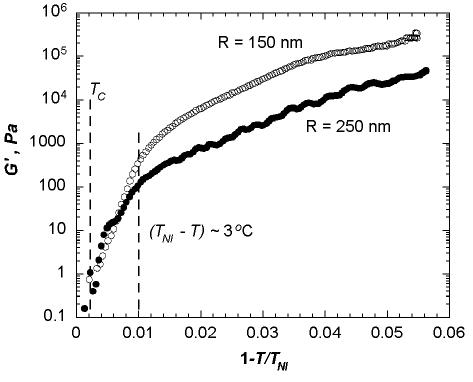
solid: pictures show PMMA particles in
5CB are densely aggregated on thin interfaces and
look at the modulus!... {That's right, it
is is not a mistake: 105 Pa}
The
latest... Let's return to Liquid
Crystal Colloids.
We know colloid particles wouldn't like to be homogeneously dispersed in
a nematic matrix - they will aggregate to reduce the elastic energy. Well,
in some cases we can make them aggregate into a really rigid
cellular
solid: pictures show PMMA particles in
5CB are densely aggregated on thin interfaces and
look at the modulus!... {That's right, it
is is not a mistake: 105 Pa}(Wilson Poon and the Edinburgh team are also interested in this effect)
* * *
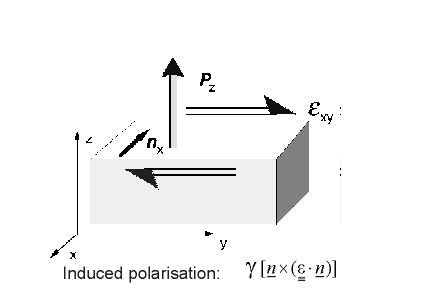
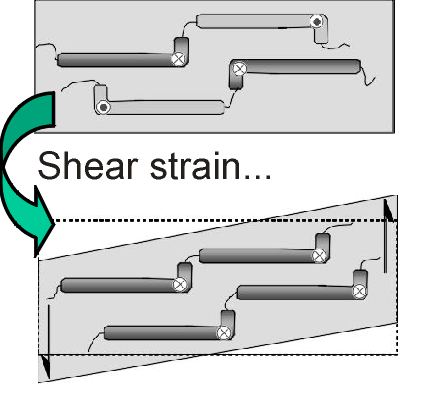
Imagine a piezoelectric rubber sheet - you stretch it or press on it and it responds with a charge!
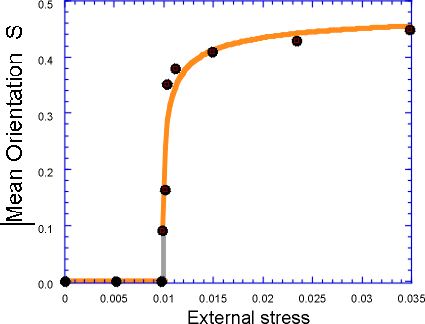
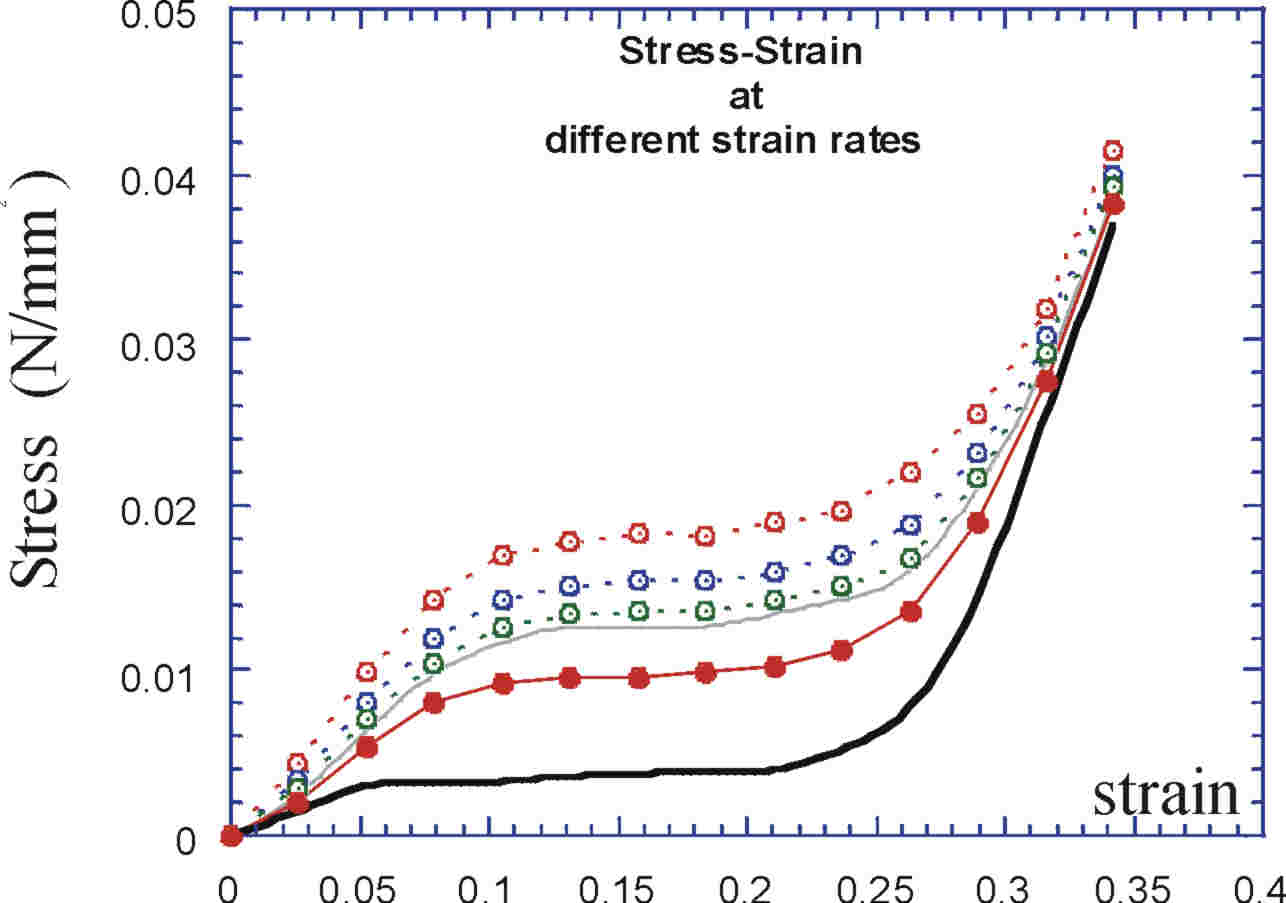
 (A magnetic field to a spin glass, a stress to a polydomain
nematic elastomer, etc...) Obviously, at high field the system will
align, but there seems to be a phase transition at a critical value of
field, between a "mathematically disordered" state and the one with small
but finite long-range order: see the work with S. Fridrikh in
recent
abstracts.
(A magnetic field to a spin glass, a stress to a polydomain
nematic elastomer, etc...) Obviously, at high field the system will
align, but there seems to be a phase transition at a critical value of
field, between a "mathematically disordered" state and the one with small
but finite long-range order: see the work with S. Fridrikh in
recent
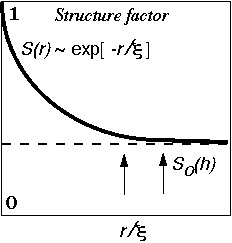
abstracts.The critical magnetic field may be too small in spin glasses, but it looks like the experiment on stretched nematic elastomers has seen this transition all along. The critical stress depends on nematic order parameter, the mean orientation order fits the S(h) plot above to an amazing accuracy...
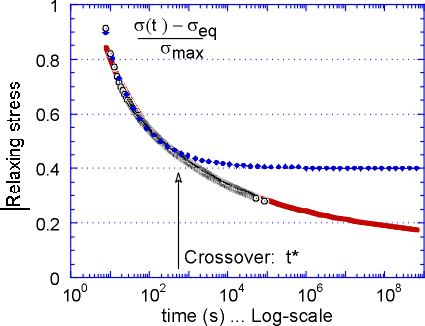
Now ask yourself - how long would it take to reach the equilibrium? All randomly disordered systems exhibit slow relaxation - but the polydomain (spin-glass like) nematic rubber is very slow... See some experimental results and a theoretical model of singular self-retardation in the recent paper with S.Clarke
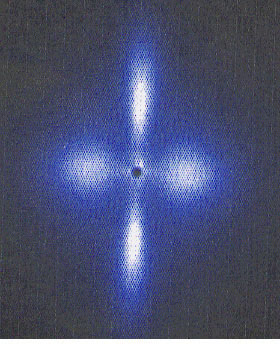

Stuart Clarke and I will do a lot more of this light scattering in the near future, as well as experiments on slow relaxation, mechanical transitions and even piezoelectricity. Peter Olmsted is also interested in the theory...
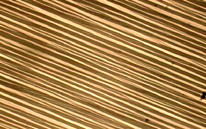
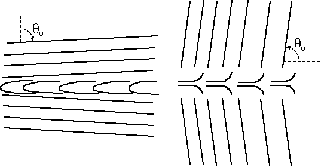
See a page of recent abstracts about liquid crystal elastomers - and check what Mark Warner and Giles Verwey have to say about it ...
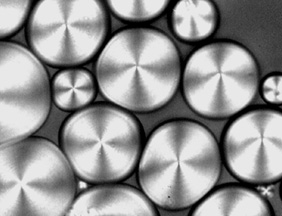
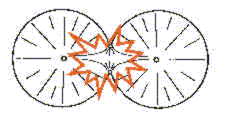
Liquid crystalline colloids have emerged as a prominent area of research and applications in the last 2-3 years; this also includes nematic or smectic (lamellar) systems filled with colloid particles, and their equilibrium and kinetic properties. See some recent abstracts on this subject.
